PLAN YOUR GREAT MIGRATION SAFARI WITH EXPERT ADVICE
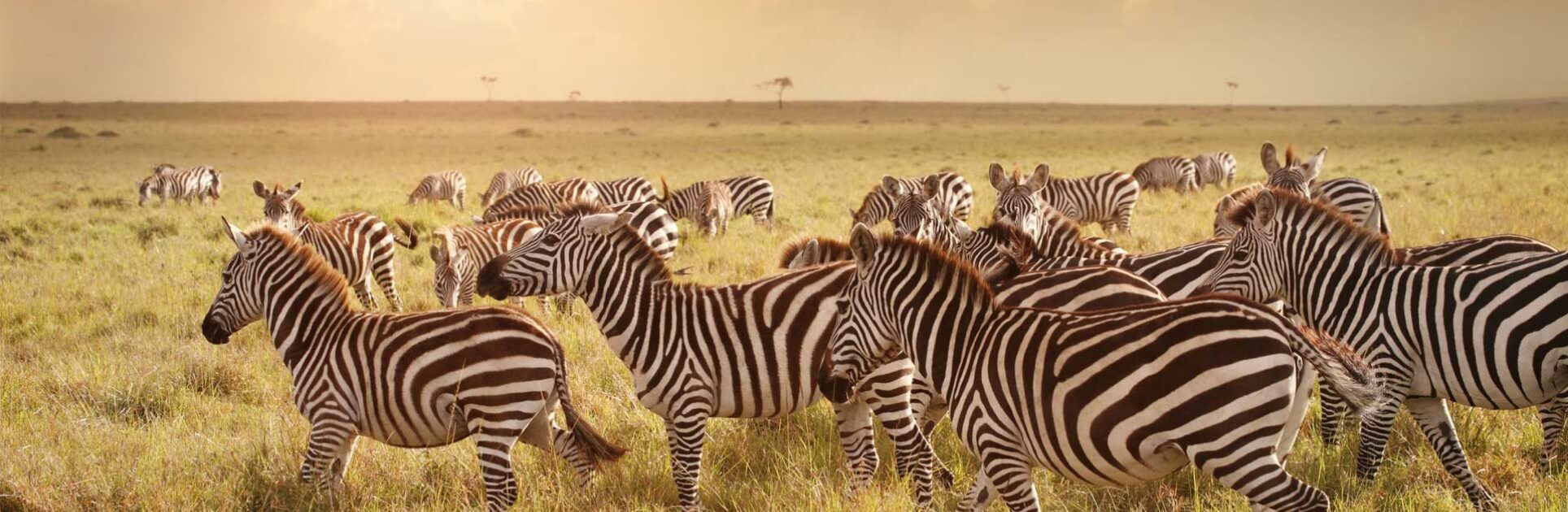
The Great Migration is the largest overland wildlife movement on Earth. Each year, approximately 1.5 million wildebeest, 400,000 zebra, and 200,000 Thomson’s gazelle travel in a continuous circuit through Tanzania’s Serengeti and Kenya’s Masai Mara in search of fresh grazing — driven by rain, grass, and instinct.
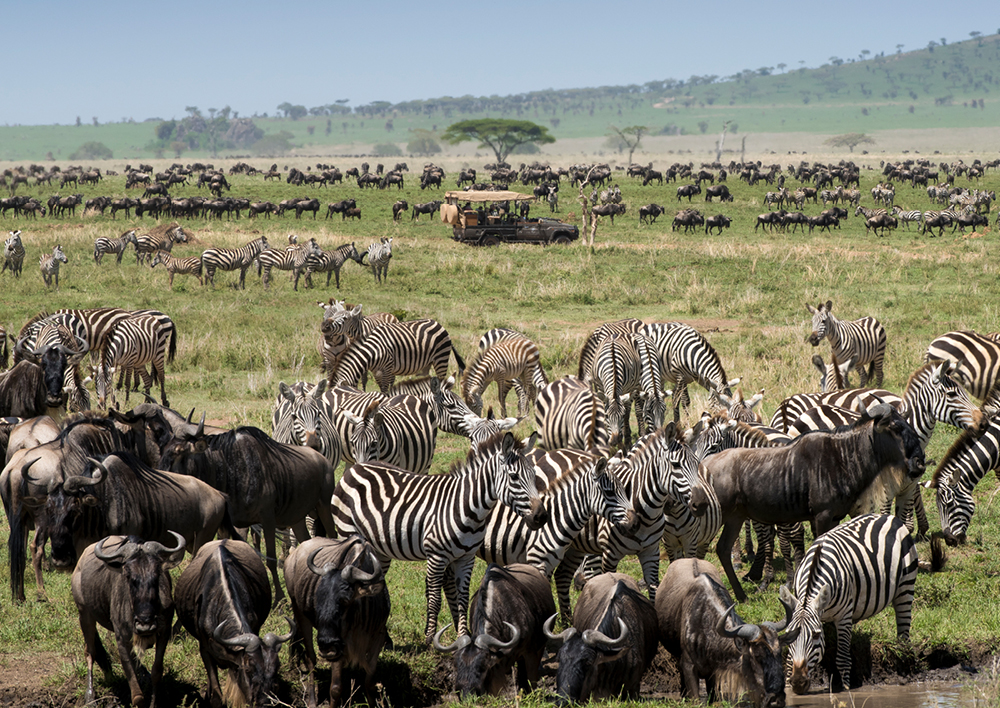
The Great Migration is a year-round event, not a single spectacle. African Safari Consultants designs itineraries around every phase of the cycle — from the calving season to the famous Mara River crossings. Contact us to plan your migration safari.
GREAT MIGRATION FACTS
- Approximately 1.5 million wildebeest participate in the annual migration
- The circuit covers roughly 1,800 kilometres across Tanzania and Kenya
- Around 250,000 wildebeest die each year from predation, drowning, and exhaustion
- The migration has no fixed start or end date — it is a continuous cycle driven by rainfall patterns
- The Mara River crossings (July–October) are the most dramatic and most visited phase
- The calving season (January–February) is less crowded and arguably a rewarding phase
GREAT MIGRATION MONTH-BY-MONTH: WHERE THE HERDS AND PREDATOR ACTION IS THROUGHOUT THE YEAR
| Month | Location | Key Event | Crowd Level |
| January | Ndutu / Southern Serengeti, Tanzania | Calving season peaks — 8,000 calves born per day | Low–Medium |
| February | Southern Serengeti, Tanzania | Calving continues; cheetah and lion activity very high | Low–Medium |
| March | Central Serengeti, Tanzania | Herd begins moving north; green season ‘long rains’ start | Low |
| April | Central Serengeti, Tanzania | Northward movement continues through ‘long rains’ | Very Low |
| May | Western Corridor, Tanzania | Grumeti River crossings begin. ‘Long rains’ begin to dissipate | Low |
| June | Western Corridor / Northern Serengeti | Grumeti crossings intensify; dry season begins | Medium |
| July | Northern Serengeti & Masai Mara, Kenya | Mara River crossings begin — peak drama | High |
| August | Masai Mara, Kenya | Peak Mara River crossings; highest density in Kenya | Very High |
| September | Masai Mara / Northern Serengeti | Crossings continue; herd starts to split | High |
| October | Northern Serengeti, Tanzania | Herd moves south; crossings back across the Mara River | Medium |
| November | Eastern Serengeti, Tanzania | ‘Short rains’ arrive; southward movement accelerates | Low–Medium |
| December | Southern Serengeti, Tanzania | Return to calving grounds; cycle begins again | Low |
Tip from our consultants : The herds are on the move throughout the year, following food and water in a continuous cycle. It is the dramatic river crossings at the Mara and Grumeti Rivers that have become iconic “bucket list” safari moments — but these can never be guaranteed. Crossings vary in timing and intensity from year to year, depending on rainfall and conditions.
MARA RIVER CROSSINGS: WHEN & WHERE TO SEE THEM
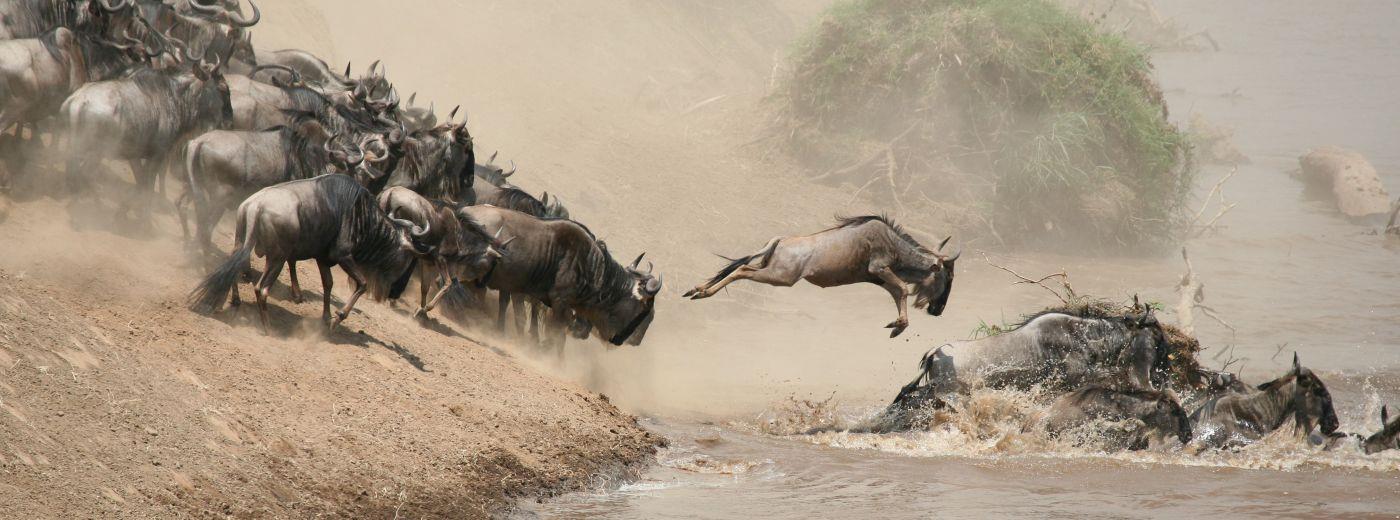
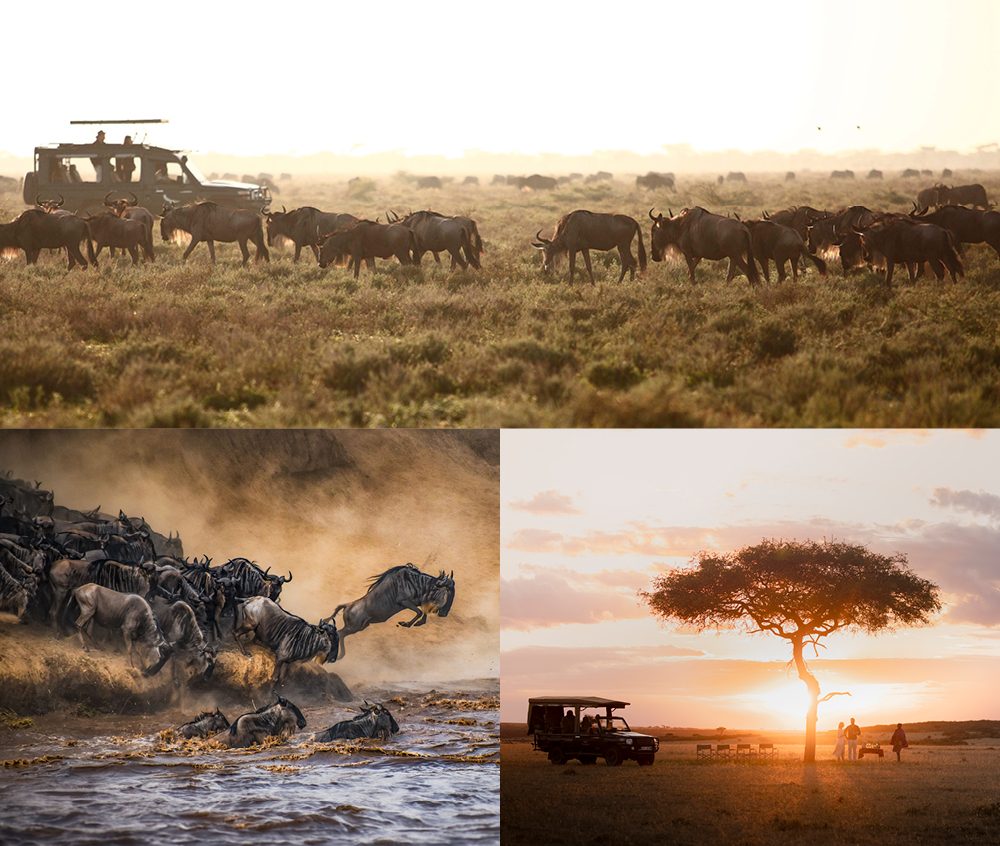
The Mara River crossings are the most dramatic event in the migration calendar, typically occurring between July and October in Kenya’s Masai Mara National Reserve and the adjacent Serengeti. Thousands of wildebeest gather at the river bank, often hesitating for hours before the herd surges across in a chaotic mass of bodies, spray, and crocodiles.
Crossings are unpredictable — they can happen multiple times per day or not at all for days at a stretch. The best strategy is to spend at least 3–4 days in a camp close to a known crossing point. The most-visited crossing sites are on the Mara River near the Serengeti’s northern boundary and at the Musiara Marsh area of the Masai Mara.
Tip from our consultants: Private conservancies bordering the Masai Mara that have access to the Mara River offer the the same migration access with a fraction of the vehicle numbers. We strongly recommend these over the National Park for a more exclusive experience. However guests staying in conservancies that are further north, without direct access to the Mara River, will need to go into the Masai Mara National Park to see migration activities.
GREAT MIGRATION CALVING SEASON IN THE SERENGETI
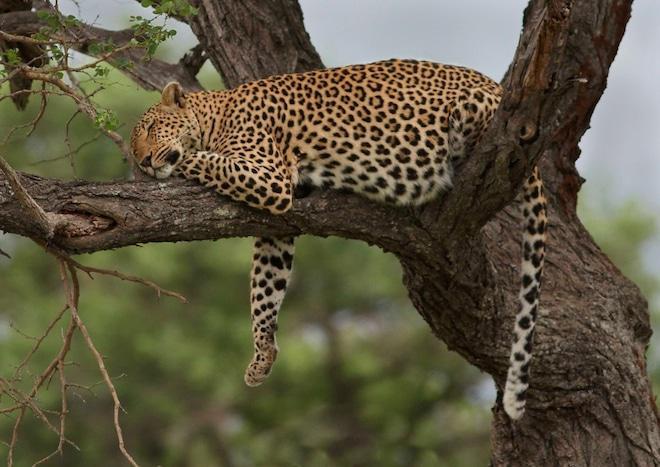
The calving season (January–February) is one of the migration’s most underrated phases. Around 400,000 wildebeest calves are born on the short grass plains of the southern Serengeti and Ndutu area in a matter of weeks — a survival strategy that overwhelms predators through sheer numbers. Cheetah, lion, leopard, wild dog, and hyena are all highly active during this period.
The calving season is significantly less crowded than the river crossings and generally less expensive. The southern Serengeti and Ndutu area offer vast open plains ideal for photography, with excellent visibility across flat terrain.

GREAT MIGRATION SAFARI FAQs
When is the best time to see the Great Migration?
The best time depends on which phase you want to see. For dramatic Mara River crossings, visit between July and October. For the calving season and intense predator action, January and February in the southern Serengeti are outstanding. June in the Western Corridor offer the Grumeti River crossings with far fewer visitors.
Where does the Great Migration take place?
The Great Migration takes place in a continuous circuit across the Serengeti ecosystem in Tanzania and the Masai Mara in Kenya. The full loop covers approximately 1,800 kilometres. The most famous phase — the Mara River crossings — takes place in northern Tanzania and southwestern Kenya.
Is the Great Migration only in Kenya?
No. Approximately 80% of the migration takes place in Tanzania’s Serengeti National Park. The herd enters Kenya’s Masai Mara from around July to October before returning south. Tanzania offers year-round migration viewing — and often with fewer vehicles than the Masai Mara.
How many days do I need for a Great Migration safari?
For the river crossings, allow a minimum of 4–5 days in one location — crossings are unpredictable and you may need to wait for the herd to commit. For the calving season, 3–4 days in the Ndutu area is usually sufficient. A 7–10 day itinerary in a combination of the Serengeti and the Masai Mara works well, potentially offering multiple crossing opportunities.
Can I see the Great Migration without visiting the Masai Mara?
It depends…. The northern Serengeti in Tanzania offers great river crossing experience — often with fewer vehicles than the Masai Mara — BUT it is important to understand that the herds move back and forth between July and October.
Where to Stay for the best Great Migration experience
| Best Camps by Phase | Recommended Location | Camp Type |
| Best Camps for the Calving Season (January–February) | Ndutu & southern Serengeti, Tanzania | Mobile camps and permanent lodges in Ndutu Conservation Area |
| Best Camps for the Grumeti River Crossings (May–June) | Western Corridor, Tanzania | Camps near the Grumeti River |
| Best Camps for the Mara River Crossings (July–October) | Masai Mara or Northern Serengeti | Private conservancy camps or northern Serengeti tented camps |
| Best Lodges for Year-Round Migration Viewing | Central Serengeti, Tanzania | Permanent lodges with daily game drive access across the ecosystem |
READY TO PLAN YOUR PERFECT MIGRATION SAFARI?
Got questions about which safari camps and lodges would work best for you? Would you love to pair your East Africa safari with time under a palm tree on an exotic beach?
Our safari consultants know these regions intimately. They understand the terrain, the logistics, and the seasonal nuances that can make or break an itinerary. More importantly, they know how to tailor a safari that fits both your timing and your travel style.
Get in touch with Liesl Matthews, Camille Rowe, Ilze Fox, Lise Kargaard for tailored safari trip advice.
Email us now at info@africansafaris.com and we’ll put you in touch directly.